Friday, April 30, 2010

Save St. Vincent's Hospital

Community Town Hall Meeting on St. Vincent's Hospital
Come ask questions and get involved in organizing our community to fight for a hospital in Lower Manhattan and nothing less !
Date: Friday, April 30, 2010
Time: 7:00pm - 9:00pm
Location: Hudson Guild (Fulton Center - 9th Ave between 17th and 18th Sts)
Address: 119 9th Avenue, New York, NY

Sunday, April 25, 2010

Repealing self-dealing

UPDATED !
The « Pelican Brief » on Mike Bloomberg's ethics

Ever since I received the latest comment ("Somehow when Mike Bloomberg does something good, he doesn't get any credit. A few minor issues seem to invalidate all the good he does in people's minds.") from an anonymous YouTube profile ("hoochee003"), I've been thinking about how to state in one clear blog post one of the "few minor issues," which highlights how Mayor Michael Bloomberg has breached the social contract, which gives him the right to govern New York City.

John Alan Cohan once wrote that there is a "popular perception that government officials serve their own purposes and those of influential interest groups, rather than those of the public." Further, "the public sees politicians as disconnected from the fundamental principles they ought to be serving." Let's examine the record, to see how Mr. Cohan's statements, although not made about Mayor Bloomberg, can still apply to the shady way that Bloombo Dicto bent the laws to run for a controversial third term as mayor.

In early 2008, Mayor Bloomberg decided to bow out of the race for U.S. President. Because the presidential race proved to be so costly and the public was suffering from Republican fatigue, Mayor Bloomberg, who was already nearing the end of his maximum two terms as mayor of New York City, had to look for another gig. By late 2008, Mayor Bloomberg decided to keep his mayoral title, even though, at the time, it was against the law.

While he was holding a public office, Mayor Bloomberg thought that there was nothing wrong with choosing to change the law with a self-serving result to help him win another, previously-forbidden, election. In addition to striking a deal with the City Council to change the law, as was correctly predicted by artist and political activist Suzannah B. Troy in her prophetic YouTube video, but the Mayor was also able to get his way by striking another deal with a respected private citizen, who had the important role of being a government watchdog.

Within days of having publicly acknowledged or announced his intention to change the laws banning third terms for local politicians, Mayor Bloomberg reached an agreement with civic activist and term limits champion, Ronald Lauder. Mr. Lauder, who had twice underwritten voter referendums that put into place restrictions of two term for local, elected government officials. The pact called for Mr. Lauder to support Mayor Bloomberg's ill-conceived, self-serving term limits extension in exchange for Mayor Bloomberg offering Mr. Lauder an appointment to a city charter revision commission to be formed by Mayor Bloomberg, once Mayor Bloomberg had safely been reëlected to a third term.

Mayor Bloomberg's excuse for needing to run for a third term was that he offered the kind of leadership (aka "fiscal prudence") needed by the city to get through the financial crisis. His strategy involved baiting many term limits' compromised City Councilmembers to vote through a self-dealing extension of term limits; not only would Mayor Bloomberg be eligible to run for a previously-unavailable third term, but so would council members, like Council Speaker Christine Quinn, who were publicly thought of being interested in running for mayor, but who now had to kill 4 more years because they were afraid to publicly challenge the powerful mayor. Since Mayor Bloomberg had decided to bow out of the 2008 presidential race, now everybody else had to put the advancement of their political careers on hold, too.

And if that wasn't enough, midway through the 2009 campaign season, the City Council, which was caught up in a slush fund scandal and had nevertheless passed Mayor Bloomberg's extension of term limits, made its own foray into compromising another important government watchdog : the Office of the Public Advocate. After the Public Advocate publicly criticised the manner in which the City Council and the mayor were changing the term limits law, the City Council proposed a budget, which was accepted by Mayor Bloomberg, which slashed the Public Advocate's budget by an unbelievable 40 per cent. The "job of the Public Advocate is, most fundamentally, that of a watchdog, ensuring that all New Yorkers receive the City services they deserve and have a voice in shaping the policies of their government." (As a matter of fact, the City Council continues to fret anytime the Public Advocate makes mention of the City Council's slush fund scandal.)

After having spent a record amount of money as of November 2009 (over $100 million) to win his ill-fated third term, Mayor Bloomberg only "won by fewer than 5 percent points, at a cost of roughly $20 million for each point," The New York Times reported. Undoubtedly, there was a backlash by the voting public to the cynical method used by Mayor Bloomberg to win reëlection. Fast-forward to March 2010, and Mr. Lauder decided to decline the offer he had accepted in October 2008 (to have served on the karmically-doomed city charter revision commission, which was widely expected to have reset term limits back to two terms). Looks like Mayor Bloomberg was losing the political cover he needed to cloak his machinations and transactions with any shred of credibility.

In social contract theory, it can be said that public servants have a responsibility of respecting a duty of care when carrying out their official tasks. The idea of this theory is that when you first run for public office, you are making an implied promise to give up self-dealing and self-interest for the greater good of society. It's supposed to motivated by a selfless act of wanting to give, not a selfish act of expecting to receive.

In response to hoochee003's request to show cause, the bottom line is that, when we all look back at what hoochee003 may call a "minor issue," we rightly see the manipulative manner in which Mayor Bloomberg fabricated a case to win his third term as mayor of New York City. Mayor Bloomberg essentially and intentionally deceived voters into believing that we needed the business expertise of his billion dollar deal-making in this time of financial crisis so that we could benefit from his personal business acumen. And just like there were no weapons of mass destruction in Iraq to justify its invasion, likewise there is no proof that New York is served better as a result of Mayor Bloomberg's financial expertise to justify the enactment of a self-dealing loophole to the term limits law. Two prime examples come to mind : the bottomless hole in the MTA's deficit and the closing of St. Vincent's Hospital. If it can be said with genuine sincerity that each new announcement of the MTA's budget deficit, which incidentally seems to come far more frequently than the G train, only come as a "surprise" to politicians, then what explains the fact that the Bloomberg administration actually "anticipated" the closing of St. Vincent's Hospital -- yet did nothing about it ? Where has the mayor's financial acumen been on display ? If the financial insolvency of neither a subway system that carries millions of people each day, nor a hospital critical to the care and lives of many thousands of New Yorkers trigger the leadership of such a financial genius that we have in Mayor Bloomberg, then what will ?

Meanwhile, it is difficult not to imagine that Mayor Bloomberg stands to personally gain from clinging onto the mayoral office for four more years, until such time as he could perhaps reconsider running for president in the next election cycle. This has all been a patent violation of public trust, which is, if you will recall, an important underpinning of the social contract we make with one another in a representative democracy. Whereas, in the case of Mayor Bloomberg's third term win, his acts of self-dealing involved misappropriation of opportunities, not money. In contrast to what Mr. Cohan wrote, the "key to reëlection or winning an election" may not necessarily only be "money," but could also include compromising the integrity of government watchdogs, like Mr. Lauder or the Public Advocate.

Now, therefore, if social contract theory calls for selflessness, then we can all agree that that is not how we can describe the political machinations and transactions Bloombo Dicto needed to bring about, in order to to win his third term. He used his position of power and influence over the City Council and government watchdogs.

Sometimes, I wonder whether if it can be shown that a self-dealing politician can be considered a fiduciary, whose powers of the purse make him accountable to a higher standard of ethics and professionalism, then would it constitute a breach of the fiduciary responsibility or relationship for that self-dealing politician to have engaged in machinations or transactions that benefited himself ? Could a courageous citizen come forth and make a showing that they were harmed by the self-dealing changes in term limits or the decimation of the Public Advocate's budget ? Could such a cause be able to recover the citizen's loss of property or rights, as well as disgorge the politician's wrongful profits or winnings ?
What kinds of profits or winnings can a wealthy mayor pocket if all he earns is $1 per year ? The perks that come with being a top government official can actually save a billionaire a lot of money. The high level of security that an otherwise wealthy private citizen would have to pay can be substantial. But if you also happen to be wealthy and mayor of New York City, you can make out very well by receiving security in form of NYPD escorts at your discretion. A wealthy citizen, who just so happens to also be mayor, can put many of his campaign workers onto the city's payrolls, in order to transfer the expenses of their employment from one's pocketbook to the city's treasury. Furthermore, a wealthy politician can also appoint city employees to represent his various private charitable efforts, which also serves to help one save money and perpetuate his power over important city cultural institutions. Still further yet, a politician can also save money on publicity, like asking the city to create or broadcast video footage of one's numerous vanity trips, for the sole purpose of building one's political brand.


For billionaires, whose assets are comprised of or concentrated in one single large investment or business ownership (but who may or may not also be cash poor), finding ways to transfer one's lifestyle expenses can save a billionaire from having to draw down his ownership, or turn to borrowing against his ownership interest, in his flagship enterprise. This is all hypothetically-speaking, mind you, but besides the prestige, there are all of the above financial motivational factors that can inspire a wealthy businessman to become a politician or, at least, encourage him to cling to his political title, even if he deceptively claims he is a selfless public servant. It could take the form of this : pretending to do public service as charity by paying oneself only $1 per year. Do you see how that might work ? Taxpayer money is going to pay for a wealthy person's lifestyle, not to further any service to the public.

Meanwhile, that other government watchdog, the editorial board of The New York Times, which endorsed Bloombo Dicto's third term campaign, suddenly is finding something wrong with the rubber stamp nature of the city charter revision commission. This is the very city charter revision commission, which was supposed to include Mr. Lauder and which was born out of a deal to let Bloombo Dicto keep his office until the next presidential campaign. Why should it come to anyone's surprise that nothing good can ever come out of such ill-fated, karmically-doomed self-dealing ? How can a reasonable person have any altruistic expectation from a compromised city charter revision commission that was created with no regard to public trust ?

Tuesday, April 20, 2010

The return of the YouTube Hater, Online Bully, and possible Identity Thief

Anonymous YouTube Hater profile hoochee003 (possibly aka BloombergForLife, CIoeBuckingham, LordCarruthers, hoochee002, et al.) strikes again.

On YouTube, we all know about members who leave nasty comments. We call them, "haters." But some members cross the line, like the owner of the anonymous profile, "hoochee003."

During the 2009 campaign for New York City mayor, hoochee003 posted many harassing comments on the activist YouTube videos that were made by Suzannah B. Troy and I. Some of hoochee003's comments were inane and harmless, but the volume of comments were sometimes great, and the fact that hoochee003 would jump from one activist's YouTube account to another showed that his intention was to harass and bully online activists.

Since many anonymous comments were posted on our videos leading up to last year's mayoral election, it has become suspicious that so many hateful, nasty, and negative comments could be generated in such a short period of time from a series of anonymous YouTube profiles. One of the anonymous profiles even represented that he was Tony Avella, the former New York City Councilman. At times, it has been thought that all of these anonymous profiles were the act of one person working under different YouTube usernames. After Ms. Troy informed the real Mr. Avella of the suspected identity theft, action was taken to suspend the fraudulent account.

As a result of the way Mayor Michael Bloomberg and the New York City Council denied voters a referendum on term limits last year, an internet community was created, in opposition to the unethical and highly questionable official acts by the Mayor and City Council Speaker Christine Quinn. Because many online activists were linking to each others' blogs, online posts, and YouTube videos, these anonymous profiles were able to stalk the opposing online activist community. There is evidence to show that the owner of an anonymous profile would jump from one activist's message to another's, in a series of coordinated actions, the sole intention of which could only be described as harassment.

This week, one of those anonymous YouTube profiles has returned to further post hateful comments.

If the Internet is all about the democratisation of communication and interconnectedness on a massive, world-wide scale, then there is something wrong when the likely owner of a series of YouTube profiles abuses the platform that is supposed to facilitate a two-way conversation over the Internet. Where the owner of these anonymous profiles may cross the line is that his or her actions can be deemed harassment, because the hateful comments are perpetual, there is no way to have a meaningful conversation with the profiles' owner, and the one-sided nature of the offensive comments only causes frustration and are clearly intended to disturb or upset the productive online community. It threatens to disturb, silence, or censor the independent voice of online activists, who are trying to make a positive contribute to the online community and to New York society.

From September 22-23, 2009, Ms. Troy's YouTube account was suspended by YouTube for reasons that were never clearly explained. This possible act of censorship by YouTube (many of Ms. Troy's videos involve the subjects of her art, her reviews of the arts, and her views of politics) is in striking contrast to how YouTube tolerates anonymous users like hoochee003 (and other online bullies), who post pejorative, racist, sexist, offensive, and homophobic comments.

How can YouTube respect hoochee003's freedom of speech, when it clearly lacks the integrity to respect Ms. Troy's ?

Tuesday, April 13, 2010

Reflecting badly on Bloombo Dicto

Quoted entirely from The New York Times, but with an added hyperlink at the very end :
Editorial : Redoing the City Charter
Published: April 9, 2010

To help quiet the uproar about changing New York City’s term-limits law so he could run for a third term, Mayor Michael Bloomberg promised to set up a commission to rethink the City Charter from top to bottom. The mayor has said “every issue will be on the table, and every voice will be heard,” which is appropriate for what amounts to the first major review of the city’s governing constitution since 1989.

The committee began work last week and already there are uncomfortable signs that issues of particular interest to Mr. Bloomberg — like term limits and nonpartisan voting — will be hurried through in an effort to get them on the ballot in November. That would be a serious mistake, and reflect badly on the mayor and the 15 able civic leaders he has named to the commission.

Any broad recasting of the City Charter has to be done methodically and fairly. That cannot possibly happen in time for this November’s ballot. The following November is not a good choice either, because there would be little else to draw voters to the polls. The most sensible date would be 2012, even if that means reappointing the commission beyond its two-year term.

The commission’s chairman, Matthew Goldstein, chancellor of the City University of New York, has promised to keep some distance from City Hall and engage in “extensive public outreach” before any proposals are made. His first effort was not encouraging. On very short notice, only about 100 people showed up for the commission’s only scheduled public hearing in Manhattan. One official rightly deemed the turnout as “disgraceful” for a city of opinionated people.

The abbreviated session further reinforced suspicions that the whole exercise is really aimed at getting a swift vote this year on term limits and nonpartisan elections. Term limits are a seductive but fundamentally undemocratic idea that can prematurely terminate the careers of some very good public servants. Voters should decide who gets thrown out of office and who stays longer on the job.

Nonpartisan elections are another lofty-sounding idea that create more problems than they solve. Political parties can keep good candidates from succeeding, but parties vet many more. Winners in nonpartisan elections often turn out to have only one real asset: loads of cash. Nonpartisan elections also could undermine New York’s model campaign financing laws.

There are other important issues that need to be addressed. The comptroller, not the public advocate, should assume the mayor’s duties if the mayor can no longer serve. The city’s land use system needs rethinking. Ways should be found to encourage more candidates to run for office and to increase voter turnout.

The last major charter revision was almost three years in the making. Slapping a few politically charged items on the ballot this fall is a recipe for mischief. The commission must do it right: aim for 2012.

Monday, April 12, 2010

Charter revision, barter commission

Copied entirely from The New York Times :

Flashback to October 2008 : Groups See Ethics Violation In Mayor's Pledge to Lauder

By MICHAEL BARBARO
Published: October 10, 2008

Two civic groups said on Thursday that Mayor Michael R. Bloomberg violated the city's ethics laws when he pledged to put Ronald S. Lauder on a charter revision commission in exchange for his support for the mayor's third-term effort.

The groups, the New York Public Interest Research Group and Common Cause, made the charge in a complaint filed with the city's Conflicts of Interest Board.

Mr. Lauder, who underwrote the campaign in 1993 to create the city's two-term limit for elected officials, had posed a serious threat to Mr. Bloomberg's plans to legislatively allow a third term.

Mr. Lauder had vowed to oppose the mayor's plan to make a three-term limit permanent, until Wednesday, when Mr. Bloomberg promised to appoint him to a charter revision commission that could return the law to its original limit of two terms.

The civic groups contend that the deal violates a provision of the City Charter, which says that a mayor cannot ''use or attempt to use his or her position as a public servant to obtain any financial gain, contract, license, privilege or other private or personal advantage, direct or indirect, for the public servant.''

In their complaint, the groups said that ''we believe that Mayor Bloomberg has used his position in a prohibited manner to obtain personal advantage in a quid pro quo deal with Ronald Lauder.''

Mr. Lauder's support, they said, represents a ''a great gain, given Mr. Lauder's track record of spending millions to defend the current two-term limit.''

Jason Post, a spokesman for the mayor, said there was no conflict of interest. ''This is purely a publicity stunt by people who are distorting the intent of the conflicts law because they disagree with the mayor on a matter of public policy.'' He added: ''It's the first of what will likely be many headline-seeking activities to prevent the City Council from exercising its authority to change a local law.''

Gene Russianoff, a senior lawyer for the New York Public Interest Research Group, said that ''more and more, the mayor looks like just another politician desperate to do anything to save his government job.''

Two members of the City Council filed a separate complaint on Thursday with the Conflicts of Interest Board. The members, Bill de Blasio and Letitia James, contend that extending term limits would be self-dealing, since it would allow legislators to seek a third term in office.

Like the civic groups, the council members cited a city law that prohibits elected officials from using their positions for ''private or personal advantage.''

Friday, April 9, 2010

Save St. Vincent's Hospital

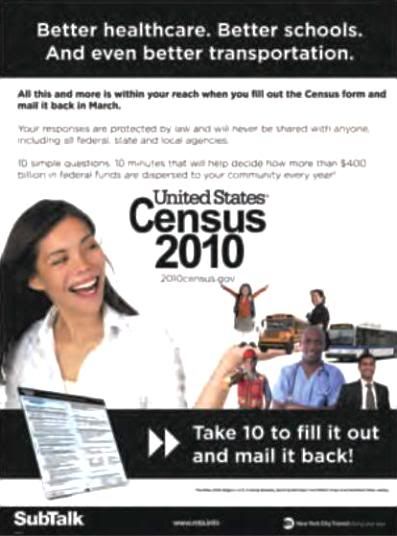
The US census nonsense us : St. Vincent's Hospital is closing before the 2010 Census can confirm that we really need it to stay open.

Count us down and out.

According to an exposé on NY1, "Mayor Michael Bloomberg says the city had been anticipating the closure of St. Vincent's Hospital, and that the New York City Fire Department is ready to take over the hospital's 13 ambulance tours as soon as it is needed."

Naturally, this is the same FDNY that the Mayor is trying to gut with his plans for disastrous layoffs, dangerous firehouse closings, and devastating budget cuts.

The closing of St. Vincent's Hospital is occurring during the 2010 Census. Meanwhile, back at the New York State census website, we are told propaganda on the FAQ page that analysis of the census would help determine whether our communities need more hospitals.

4. How does census information affect my community?

Census data is used to determine the need for social services, including community development block grants and other grant programs essential to many communities. Census information helps determine locations for schools, roads, hospitals, child-care and senior centers, and more.

2010 Census,MTA SubTalk Poster

Back to the NY1 exposé article, the importance of St. Vincent's Hospital on the community was analysed by these precious statistics : "St. Vincent's currently employs 3,500 people and averages 60,000 emergency room visits per year."

Sounds like the hospital is needed now, and is pretty vital to the community, now don't it ?

Tuesday, March 30, 2010

Running for the Exits

Quoted entirely from The New York Times.

Another Exit From Bloomberg’s Inner Circle

By MICHAEL BARBARO
(David W. Chen contributed reporting.)

Mayor Michael R. Bloomberg so prizes stability and loyalty that he discouraged goodbye parties for employees of his media company, writing in his memoir that he could barely bring himself to wish departing workers good luck. “Why should I?” he asked.

Now he finds himself, however reluctantly, bidding farewell to his closest advisers at City Hall, who are leaving for lucrative jobs in the private sector.

In the process, they are forcing Mr. Bloomberg to remake an inner circle that has remained remarkably consistent, and free of drama, over the last eight years.

On Tuesday, Deputy Mayor Edward Skyler, who manages the city’s Police, Fire and Transportation Departments and the Office of Labor Relations, and who is arguably Mr. Bloomberg’s most powerful aide, said he would take a job at Citigroup in May.

Joining him in the exodus: Deputy Mayor Kevin Sheekey, the mayor’s political guru and chief of government relations, who will soon leave City Hall for a position at the mayor’s company, Bloomberg L.P., and James Anderson, Mr. Bloomberg’s communications director, who took a job with the mayor’s charitable foundation.

After Mr. Bloomberg’s improbable victory in the 2001 mayor’s race, both Mr. Skyler and Mr. Sheekey followed him from his company to City Hall. Since then, they have been a part of an enormously influential coterie of advisers.

They have advised him on everything, like his short-lived flirtation with a presidential run (spearheaded by Mr. Sheekey), the revamping of the city’s Buildings Department (a project run by Mr. Skyler) after several crane collapses and his decision to seek a third term as mayor (both advised him not to).

“They have been with the mayor the longest, and they are totally loyal to him,” said William T. Cunningham, who was communications director during the mayor’s first term.

But the changes inside Bloomberg Land do not end there. Since he decided to seek a third term last fall, Mr. Bloomberg has announced the departure of 15 high-level aides, most of them agency commissioners. It is a level of turnover without precedent during his time in office.

“He’s had a very stable crew,” said Andrew White, the director of the Center for New York City Affairs at the New School. “It was actually surprising to a number of people that there was so little change after the last election.”

Aides to the mayor said he was both fulfilling a campaign pledge to shake up his administration during his third term and allowing long-serving advisers to begin new careers outside of government, with his blessing.

That was the case with Mr. Skyler, who will become an executive vice president at Citigroup, overseeing the firm’s relationships with reporters, investors and government agencies.

Mr. Skyler, 36, is the city’s youngest deputy mayor, but he shoulders the greatest responsibilities, managing highly visible operations — like the efficiency of ambulance response times and trash pickups — by which most New Yorkers measure the effectiveness of their government.

A lanky former Ivy League fencer who grew up on the Upper East Side, he found himself at the center of grueling debates about how to identify human remains found at ground zero years after the Sept. 11 terrorist attacks and how to handle the cleanup of the steam pipe explosion near Grand Central Terminal in 2007.

Mitchell L. Moss, an informal adviser to Mr. Bloomberg and a professor at New York University, called it “an exhausting job.”During a news conference in the Bronx on Tuesday, Mr. Bloomberg described Mr. Skyler as a “a phenomenally competent guy” who “did a masterful job for the city.” He added that he wished Mr. Skyler would remain at City Hall. “He’s got his life to lead, and he’s got to make his decisions, and he’s done that.”

Mr. Skyler is unlikely to move out of Mr. Bloomberg’s orbit entirely: the mayor’s companion, Diana L. Taylor, is a member of the Citigroup board of directors, which interacts regularly with the firm’s top managers.

Citigroup appeared intent on wooing an experienced New York figure for the job. Before Mr. Skyler began his job search, the bank had discussed the position with Mr. Sheekey; Howard Wolfson, the former communications director for Hillary Rodham Clinton’s presidential campaign and Mr. Bloomberg’s re-election bid; and Gary Ginsberg, the former chief of investor relations and corporate communications for News Corporation, the owner of the Fox News Channel and The New York Post, according to people told of the discussions. A spokesman for Citigroup declined to comment on other candidates for the job.

Citigroup said government affairs would be part of Mr. Skyler’s portfolio. The bank’s primary lobbying efforts are aimed at the federal government, which gave the company billions of dollars in bailout money during the financial crisis. Mr. Skyler is prohibited from lobbying city government for the next year.

Mr. Bloomberg did not announce an immediate replacement for Mr. Skyler, but aides said a broad search would reach beyond City Hall. In an interview on Tuesday afternoon, Mr. Skyler said, “I think I was just ready to do something new, and I think that’s healthy.”

Saturday, March 27, 2010

Budget Cuts Crime Wave of 2010

Has anybody reminded Bloombo Dicto that he created these Budget Cuts, in the first place ?

"A disturbing spike in murders and other serious crimes is leading city officials to believe the NYPD’s famed 'blue line' is growing way too thin," The New York Post has reported.

"...[T]he NYPD's shrinking manpower level -- from 41,000 cops in 2001 down to about 35,000 today -- could be playing a factor in the increased crime rates. The city expects to shed around 1,300 officers in the upcoming fiscal year through attrition, and also is threatening to lay off a whopping 3,150 cops if the state slashes related funding."

For his part, Mayor Bloomberg reacted with surprise, as if he had nothing to do with the Budget Cuts Crime Wave of 2010. "We have fewer police officers than we did before," the mayor told The New York Post. "More cops always helps."

He sees no connection between his draconian budget cuts or indifferent policies in the most critical services needed by society -- for example, adequate numbers of cops and firefighters, emergency rooms and hospitals, and affordable and timely public transit -- and the quality of our lives.

Sunday, March 21, 2010

Small screen diva

' The tapes also aired on one of the city's TV stations, where they ran in endless loops, similar to the way leaders are promoted in places like North Korea. '

From The Village Voice via Queens Crap on FaceBook, but quoted entirely from Queens Crap, comes this shocking report about Bloombo Dicto's costly obsession with his self-image :

Shortly after his re-election in November 2005, Mike Bloomberg decided to raise his national profile several notches. He began traveling widely, making speeches and accepting awards. We later learned this was mostly about setting the stage for a potential run for president. He ultimately passed on that race, without giving up hope that he might get lucky next time. But one of the interesting features of this publicity push was that—despite his own fabulous wealth—the mayor wasn't shy about using city resources to promote his image.

Starting in February 2006, the Bloomberg administration began assigning a team of video camera operators from the city's television station — NYC-TV — to follow the mayor on his far-flung voyages. The mayor flew on his private jet; the city crews followed behind on commercial airlines.

At taxpayer expense, city workers traveled to Shanghai, Beijing, Bali, Paris, London, Mexico City, Belfast, Berlin, and Jerusalem. They also covered his cross-country jaunts to Los Angeles, San Francisco, Seattle, Austin, Chicago, Atlanta, Boca Raton, and Fort Lauderdale. The crews shot the mayor as well as he made his less glamorous, workaday trips to Washington and Albany.

This fascinating footage was then routed back home for use by local commercial television stations seeking to show viewers their mayor in action. The tapes also aired on one of the city's TV stations, where they ran in endless loops, similar to the way leaders are promoted in places like North Korea. Much of it was also posted for posterity on the mayor's website...

The Voice was hoping to bring this information to readers much earlier. The subject of the mayoral video teams was raised last spring by NYC-TV employees complaining how their agency was being used as a playpen for the mayor and his pals. Their complaints were sparked by a wide-ranging scandal, broken by the Voice, in which top executives at the station—all Bloomberg appointees—were forced out after they were caught abusing their posts; the financial director was arrested when it turned out he had taken advantage of his boss's frequent absences to steal some $60,000.

A Freedom of Information request for travel and expense records was filed last May. As requests go, this one was standard, plain vanilla. But DOITT officials instantly said it would take six months to compile. Why six months? Heavy traffic in the FOI department, they said. This also conveniently ensured that the information wouldn't be available until after voters had decided on the mayor's third term bid in November. Even then, six months stretched into nine. The documents finally emerged a couple weeks ago, after a lawyer was retained to get the agency's attention.

About 10 years ago, we would have expected to read this story in the NY Times.

Today, instead of corruption inside City Hall, they spend their time writing about a cracked driveway outside of it.

Monday, March 15, 2010

Ducking his duty

This post is quoted entirely from the NYPost editorial :

It's your fault too, Mike

Mayor Bloomberg has a lot of nerve criticizing Lt. Gov. Richard Ravitch's plan to pile up more debt to deal with the state's fiscal crisis.

"I think that doesn't pass the laugh test," he said Wednesday, referring to Ravitch's plan to let Albany, in part, borrow its way out of its $9.2 billion fiscal hole -- in exchange, supposedly, for "tough" new measures to impose fiscal discipline in the future.

And indeed it doesn't.

But whipping out the credit card to dodge short-term pain is hardly a new concept for Albany.

Or Mike, for that matter.

Back in 2003, Hizzoner got Albany to borrow $2.5 billion and use the cash to pay off city debts that were coming due over the next five years. The state would then repay those funds in payments stretching over the next three decades.

The bitterest irony is that the $2.5 billion was supposed to be the city's last payments on bonds issued by the Municipal Assistance Corp. to rescue the city from the '70s fiscal crises.

In other words, Bloomberg ensured that taxpayers in 2034 would be paying off expenses incurred by Mayor John Lindsay in the 1960s.

Any wonder that pols see no problem in ducking their duty again?

Sure, Mike has found religion now that the principal problem is somebody else's.

A little humility is in order, though.

Tuesday, March 9, 2010

Queens Plaza - this is crap !

"... there was a dead homeless man laying on the debris for a day and a half before anyone 'noticed' or did anything....even after we called 911 several times."

Queens Crap has dedicated an entire blog post to the Bloomblight at Queens Plaza, which, frankly, is getting out of hand. There are several photos on the Queens Crap blog post, just so that you know that we aren't exaggerating.

Monday, March 8, 2010

BloombergForLife, CIoeBuckingham, et al.

A notorious, yet anonymous, YouTube cyber stalker is believed to continue to harass the activist, political blogger, and artist Suzannah B. Troy.

Since Google refuses to take any action, Troy has turned to the empowerment tools of the internet : by launching a new Google blog in an effort to out the YouTube stalker who goes by many different aliases, among them : BloombergForLife, CIoeBuckingham, LordCarruthers, hoochee002, etc.

I invite you to read Troy's first posting on her courageous new blog.

Troy has the courage to speak out for the many of us, who were systematically stalked, harassed, and intimidated by the cyber stalker.

Sunday, February 21, 2010

Fast Cash Shuffle Stunt


John Haggerty, a Queens Republican Party operative, is in hiding after news broke that he cannot fully explain how he spent an approximate campaign finance payment of $750,000, which was channeled by Mayor Michael Bloomberg's ill-fated th3rd t3rm re-election campaign through a $1.2 million payment to the Independence Party of New York state.

Saturday, February 20, 2010

Bloomberg Shifts $5 Billion Out of Friend’s Firm

Entirely quoted from the article posted on the NYT website :
By LOUISE STORY and MICHAEL BARBARO
Published: February 19, 2010

Mayor Michael R. Bloomberg of New York has decided to remove his fortune from a private equity firm founded by his longtime friend, 10 months after that firm became embroiled in a scandal involving the state pension fund.

Librado Romero/The New York Times, left; Jin Lee/Bloomberg

Michael Bloomberg, left, mayor of New York, and his friend, Steven Rattner, founder of Quadrangle Capital Partners.

The mayor is shifting about $5 billion from Quadrangle into a new investment firm devoted solely to his interest and that of his charitable foundation. About a dozen employees of Quadrangle will join the new enterprise, suggesting the move is not being driven by a desire to change investment strategy. According to a letter that Quadrangle sent to its investors on Friday, the mayor was seeking privacy and flexibility for his investments.

In assets, Quadrangle will shrink by more than half, leaving the firm only private equity investments in the media and telecommunications industries. The setback caps a year of struggle for Quadrangle, after Steven Rattner — the founder who is Mr. Bloomberg’s friend — departed last year to run the Obama administration’s automobile task force. Mr. Rattner was linked to the New York pension fund investigation within months of that appointment and stepped down from his government role last summer.

No charges have been brought against the firm or Mr. Rattner by the attorney general of New York or the Securities and Exchange Commission, which are both investigating Quadrangle’s past dealings with the New York state pension fund.

Mayor Bloomberg’s private fortune — built around his media business, Bloomberg L.P. — fueled his improbable victory in the 2001 mayoral campaign and helped secure a close re-election last fall.

His decision to relocate his money may fuel speculation about his political ambitions: he is considered a potential candidate in the presidential campaign of 2012. If he were to run, he would undoubtedly finance the campaign himself, at a staggering cost. His aides previously put the price tag at $1 billion.

The mayor’s decision to disentangle himself from Quadrangle ends a chapter in a partnership that elevated Mr. Rattner into greater prominence in government and business, and that allowed Mr. Bloomberg to take bigger risks with his overall fortune, which is estimated at $15 billion, including his large stake in the media company.

Since leaving government, Mr. Rattner has been writing a book on the automobile industry, scheduled for a fall release, and has not said if he is looking to return to finance.

It is unclear whether Mr. Rattner might work with the mayor again. As the pension investigation unfolded, Mr. Bloomberg has steadfastly defended Mr. Rattner. At the time, the mayor praised his work and called him “a great public servant.” Initially, the mayor said he had no plans to take his investments elsewhere.

Mr. Bloomberg and Mr. Rattner remain close, frequently dining together and speaking by telephone, according to mutual friends.

Questions about Mr. Rattner’s involvement with the state pension fund emerged when the S.E.C. filed a case against middlemen who helped investment firms like Quadrangle garner business from the state. One of the middlemen was producing a movie called “Chooch,” and a company owned by Quadrangle made a deal to distribute that low-budget film, according to the S.E.C., which was investigating kickbacks.

Spokesmen for Quadrangle and Mr. Rattner declined to comment.

A spokesman for the mayor, Jason Post, said: “The fact that the mayor will be hiring the same team Quadrangle put together to manage these funds shows how pleased he is with their performance, which has been excellent. He has nothing but good things to say about the job Quadrangle has done.”

Mr. Post said that the mayor’s decision to move his money out of Quadrangle was unrelated to the state pension fund investigation.

Quadrangle has spent the last year trying to refashion itself without Mr. Rattner and focus on private equity. Investors in one of the firm’s funds voted last spring to allow the firm to continue making new investments, even though they had an option to withdraw their capital when Mr. Rattner left.

Mr. Rattner cut his ties with Quadrangle when he became a special adviser to the Treasury Department, though he still had substantial money invested with the firm. Mr. Rattner is a prominent Democratic fund-raiser, and seemed to relish the return to Washington, where he began his career as a reporter for The New York Times.

Mayor Bloomberg accounted for a substantial part of Quadrangle’s business, but because he paid lower fees than other clients, his business was less profitable for the firm.

The mayor’s selection of Quadrangle in 2008 to manage his investments was unexpected: at the time, the firm was known for brokering and investing in media deals, not as a money manager. When the firm created a new division to handle Mr. Bloomberg’s money, called Quadrangle Asset Management, it had just one client: Mr. Bloomberg.

Quadrangle recruited Alice Ruth, who had managed the personal fortune of Gordon Moore, Intel’s co-founder, to run the unit. Ms. Ruth will join the mayor’s new money management office.

Under guidelines approved by New York City’s conflicts of interest board, the mayor’s investment portfolio is managed like a blind trust, though he retains control and access to certain investment decisions, and receives regular updates on its performance.

Quadrangle’s private equity business has remained separate from the asset management unit. The firm’s first private equity fund, raised in 2000, has already returned the full amount to its investors and retains stakes in several companies. The firm’s second fund, raised in 2005, has about $500 million left to invest and was up 19 percent last year, according to the investor letter.

Despite his reputation as a financial wizard, Mr. Bloomberg did not fare particularly well in the stock market in 2008. His tax returns, abridged for presentation to the news media, showed that he lost millions on his investments as the entire market plunged, including those managed by Quadrangle.

Friday, February 19, 2010

Two Financial Plans: One Public, One Secret

CONTACT: Press Office (212) 681-4825
FOR RELEASE: Immediately April 23, 2003

MTA HID HALF A BILLION DOLLARS IN 2002 BUDGET,
FARE INCREASE BASED ON MISLEADING INFORMATION
Two Financial Plans: One Public, One Secret

The Metropolitan Transportation Authority (MTA) hid more than half a billion dollars from the public when it was asking for a fare increase by keeping two sets of financial plans, one public and one secret, according to a report issued today by State Comptroller Alan Hevesi.

Only after he subpoenaed the MTA and required testimony of officials did Hevesi's office learn of the internal plan, which showed that the MTA secretly moved funds to reduce its 2002 surplus and create a deficit in 2003. Hevesi announced a reform proposal to change the secretive culture of the MTA to make it more accountable.

"The MTA claims to be the most open agency in government, but that claim is a fraud. The MTA secretly moved resources to slash the reported 2002 surplus and create a deficit in 2003, apparently to justify a fare increase. New York City also moves funds between years, but it discloses the information," Hevesi said. "It is an outrage that this public agency blatantly misled the people it is supposed to serve."

The Comptroller's budget review found that:

  • 2002 Surplus Shrunk: The MTA's December 2002 Plan, which was the basis for the public hearings and the fare increase, showed a 2002 surplus of $24.6 million. Previously undisclosed MTA documents show that if the MTA had not planned to move $512.5 million in available resources from 2002 into 2003 and 2004, the 2002 surplus would have been $537 million.
  • 2003 Deficit Created: The public December Plan showed a 2003 deficit of $236 million. However, internal MTA documents show the agency hid $319 million by not counting it as a 2003 resource when it was available, but allocating the funds to 2004. If all the funds available to be used in 2003 were included, the MTA would have shown a 2003 surplus of $83 million.
  • Resources Shift Again: As the Comptroller's Office was concluding its review of the December Plan, the MTA Board approved a new Plan on March 27, 2003. Once it had passed the fare increase, the MTA shifted resources again, this time from 2004 back into 2003.
  • Still Hiding Money After Getting The Fare Increase: The MTA March Plan, which included higher revenues from the fare and toll increases, shows a 2004 surplus of $60 million. Only a limited review of this plan was possible before the Comptroller's report was completed, but it uncovered the surplus could be well over $140 million. Internal documents reveal another $27.5 million in undisclosed reserves. Also, the Plan includes none of the savings from the new labor agreement with the Transport Workers Union.
  • Can't Use 5-Year Plan for Planning: Despite its stated commitment to multi-year planning, the MTA produced a legally mandated five-year plan only after the Comptroller demanded it. Moreover, the five-year plan produced by the MTA is useless in determining whether future fare increases will be needed again as soon as 2005.

"No doubt the MTA will claim that a fare increase is necessary because of the deficit expected in 2004. The fact is if it had not hidden money, the MTA would have had a large surplus in 2002 and a small surplus in 2003. Thus a fare increase might not have been necessary in 2003," Hevesi noted. "The public and elected officials have a right to know the truth and debate the timing and amount of fare and toll increases based on facts, not a distorted picture created by the MTA to make it easier to push through an increase. While it may have made sense to raise fares in 2003 to smooth out the budget gaps, there were a number of choices. Metrocard and E-ZPass permit an endless combination of fare and toll increases and discounts, so there was more flexibility than the MTA admitted. Indeed, the MTA itself has already delayed implementation of the fare increase from March to May."

After twice asking for and not receiving all requested data, on February 19, 2003, Hevesi took the extraordinary step of issuing subpoenas for records and testimony from the MTA for information regarding the financial plan that was approved by the MTA Board on December 18, 2002. Pursuant to the subpoenas, the Comptroller's Office received 18 cartons of material and took 32 hours of testimony from senior MTA officials in eight sessions over the next month.

The December plan showed a two-year gap of $951 million, including $235.8 million in 2003 and $715.7 million in 2004. The MTA used those alleged gaps to justify raising subway, bus, and commuter railroad fares by as much as 33 percent and tolls on the MTA's largest bridges and tunnels by $.50.

A rapid rise in debt service costs is the driving factor behind the projected 2004 budget gap. Debt service costs are projected to total $1.3 billion in 2004, more than double the 2003 amount. By 2010, debt service costs are projected to reach $1.7 billion, due to an increased reliance on debt to finance the 2000-2004 capital program because the State is not contributing to the current capital program.

The Comptroller's report also found the following:

  • The MTA has a secretive budget process, making it very difficult to check the accuracy of its numbers or the reasonableness of its estimates for the future.
  • In a number of cases, the budget office did not maintain appropriate working papers to document how it arrived at numbers in the Plan. In several cases, the working papers did not match the numbers in the December Plan.
  • MTA staff found it difficult to recreate their own budget numbers in several critical areas. In some cases, MTA officials could not even recall how they calculated a particular number or cited professional judgment as the sole basis.
  • MTA budget staff said that much of the information for their budget preparation came from the individual agencies that make up the MTA. However, when the Comptroller's Office checked a sample of agency data, the numbers did not always match.
  • MTA financial reporting is not clear and accessible, making oversight and accountability difficult.
  • The different MTA agencies use different financial plan formats, making comparisons hard.
  • The MTA's own plans are not updated frequently. The March 2001 plan was not updated until the December 2002 Plan.
  • It is difficult to track important developments from one plan to the next. There was no explanation of many of the changes between the March 2001 and December 2002 Plans.
  • New York City presents to the public two detailed financial plans, one before gap closing actions and the other showing the effect of those actions. The MTA combines the two, which makes it difficult to understand and quantify the factors causing the gaps.
  • The MTA does not publish the detailed revenue and expenditure assumptions and methodologies behind its forecasts, which means they are not subject to review.
  • The MTA is arbitrary in its response to legal requirements to report on its finances.
  • It had ignored Section 1269-d of the Public Authorities Law that requires it to produce a new five-year financial plan every year. The last one was completed in 1999.
  • Only when the Comptroller demanded the required five-year plan did the MTA finally provide one.
  • However, the MTA arbitrarily changed the format of the plan so that it cannot be compared to past plans and used plainly unrealistic assumptions - defeating the purpose for this financial planning tool.
  • Thus the new five-year plan is of little use in determining if additional fare increases will be needed in 2005 or beyond.

"The MTA has repeatedly claimed to be the most open agency in city or state government. Our review proves that in fact the MTA has a culture of secrecy, arrogance, lack of accountability and contempt for the public," Hevesi said.

Hevesi announced the following reform measures to change the secretive culture of the MTA and make it accountable to the people it serves. First, using his constitutional authority from Article 10 Section 5 to supervise the accounts of public corporations, such as the MTA, the Comptroller will promulgate detailed regulations that will compel the MTA to submit its budget and financial plan in a manner that is transparent, timely and reasonable. The reporting will be modeled on the budget standards derived from the Financial Control Act and the New York City Charter, which result in detailed and transparent reporting of New York City's budget.

Second, the Comptroller will draft and submit to the Legislature and Governor legislation that will give to the Comptroller the authority to formally determine the accuracy, transparency and reasonableness of the MTA's budget and financial plan before the MTA can vote for any future fare and toll increase.

"The public has lost confidence in the MTA. The only way to restore that confidence is to ensure that all future financial reports are accurate and fully disclose the true condition of the agency. These proposed reforms will ensure that the true financial status of the MTA will be readily available to the public," Hevesi said.

Click here for a copy of the full report.

# # #

HOW THE MTA HID MONEY & CREATED A DEFICIT IN 2003

In its internal version of the December Plan, the MTA planned a number of actions that moved resources that were available in 2002 to future years.

Transferring Funds to Other Years Slashed the 2002 Reported Surplus

  • The MTA planned to transfer $182.5 million from its 2002 budget to an off-budget Stabilization Account that would be drawn down in 2003. If the MTA had done nothing, this money would also have been available in 2003, so the only plausible reason for putting it into this off-budget account was to hide it from the public.
  • The MTA planned to transfer $125 million in 2002 to its Corporate Account that would be drawn down in 2004 and used to fund a reserve. The reserve, which was not disclosed by the MTA in the December Plan, inflated the size of the two-year budget gap.
  • The MTA planned to transfer $65.8 million from 2002 to 2003 by prepaying debt service costs.
  • The MTA also planned to transfer $139.2 million from 2002 to 2004 by prepaying debt service costs.
  • In total, these four actions reduced the projected 2002 surplus by $512.5 million. If these actions had not been taken, the projected 2002 surplus would have been $537 million, instead of the $24.6 million the MTA reported to the public.

A Surplus in 2003 Was Turned Into a Deficit

  • The MTA planned to shift $264.2 million in surplus resources from 2002 to 2004 through debt prepayments and off budget accounts.
  • The agency had another $54.8 million in undisclosed resources available in 2003, which it planned to use in 2004.
  • Had the MTA used all the resources available for 2003, it would have had a surplus of $83 million, instead of the deficit it showed in its December Plan of $235.9 million.

The March 2003 Plan also Has Undisclosed Funds

  • On March 27, 2003, the MTA Board approved the March Plan, which includes fare and toll increases and shows a surplus of $59.8 million by the end of 2004, including a $40 million reserve.
  • Most of the surplus resources that were shifted from 2002 to 2004 in the December Plan were shifted to 2003 in the March Plan to help fund the Transport Workers Union (TWU) agreement and reportedly an increase in debt service costs.
  • A review of the internal version of the March Plan found undisclosed reserves of $27.5 million, which would raise the surplus to $87.3 million.
  • The March Plan includes the cost of the new agreement with the TWU, but not any productivity savings from newly gained management rights. Productivity savings could amount to more than $60 million, which could increase the 2004 surplus to about $140 million.

For more information:

Albany Phone: (518) 474-4015 Fax:(518) 473-8940
NYC Phone: (212) 681-4825 Fax:(212) 681-4468
Internet: http://www.osc.state.ny.us
E-Mail:press@osc.state.ny.us

MTA Doomsday: $400MM mistake

The New York City subway system, called the MTA, has lost $400 million, and the unstoppable NYC blogger Suzannah B. Troy says that, "as usual," the hardest hit will be, "New York City's most vulnerable."

As we all know, the MTA has a history of keeping two sets of financial plans.

Thursday, February 18, 2010

Annual MBO Review

Performance Management, Performance Appraisals, Employee Reviews, and Appraisal Forms

One of the leading New York City bloggers gives her review of Mayor Michael Bloomberg, the New York City Council and its Speaker, state officials, and federal politicians.

Suzannah B. Troy describes a method of performance management that is based on putting LoJack security tracking devices on taxpayer money, and then using those LoJack tracking systems to evaluate and review performance by our politicians.

Sunday, February 7, 2010

Bloomberg's grim diagnosis

Blame Bloombo Dicto 4 closing of St. Vincent's

The New York Post reported that financial tycoon and New York City Mayor Michael Bloomberg doesn't know how to keep a hospital open.

"I don't know. You don't want to pre-judge. People want to keep it open. It would be great if you could find a ways to do it. I will say, I find it hard to see how you could do that. You might be able to get it through another six months...."

Saturday, February 6, 2010

izz he serious ?

If he wants better Homeland Security for NYC, Bloombo Dicto can begin by restoring first responders.

After Mayor Michael Bloomberg proposed a city budget that would close up to 20 fire houses, the th3rd t3rm mayor last week asked Homeland Security Secretary Janet Napolitano to increase the city's federal anti-terror funding.

Before he asks the federal government to supplement the city's costs of funding programs that are important to preventing or responding to threats by terrorists, the mayor should see what the city can do for itself, namely, restore the cuts he's threatened to make to FDNY.

The mayor must seriously take into consideration that he has a role in protecting what clearly is the terrorists' No. 1 target.

The city's security is a city responsibility, and we can't afford to let local politicians get in the way. The way that the mayor is playing budgetary games with the FDNY's presence in many neighborhoods is irresponsible in the minimum, and is a threat to the city's security in the maximum.

This post is a satirical and tragic twist of a real news article published by The New York Daily News. You can't make this stuff up.

Monday, February 1, 2010

City on fire

New York City’s Fire Department Braces for Cuts

So, now that New York City voters have elected him back to office, following his ill-fated run at a doomed third term, look at what happens next, naturally :

Mayor Michael Bloomberg has proposed a city budget that would shut down up to 20 fire companies.

Hypothetically, it may take a longer time for fewer fire fighters to respond to more fires than they could have reasonably been expected to fight in the past. Delayed or prolonged response times by fire fighters can result in serious injuries, fatalities, more expensive losses connected to property damage, and devastation of neighborhood economies. The FDNY plays a critical role in the safety and security of the city.

Meanwhile, in an article in today's newspaper, The New York Times reports that the mayor's proposed closings will have dire consequences. "Response times could creep up," the article's reporter, Al Baker, concluded.

This is the objective reporting from a member of the newspaper's journalism staff, not to be confused with the editorial board, which, as you may recall, in October 2009, "enthusiastically" endorsed the mayor's karmically-doomed third term.

It makes you wonder whether we live in a dangerous city because of terrorists, or because the mayor wants to see the city go up in flames.